Four world cards number to match the deep dives below and jump-link to them, unchanged in structure from v2.
World 01
mGrant
Both sides of the money.
mGrant (Donor + CSR)
The grant-maker's side: RFP → application → grant → disbursement → compliance → impact. I built the compliance layer for India's Section 135 CSR mandate: statutory obligation calculation, budget attribution, year-end freeze, and the full set of statutory reports. Multi-year and lean grant pipelines. A four-tier results framework: input → output → outcome → impact.
mGrant NuO
The grantee's side: an NGO managing incoming funds, sub-grants to implementing partners, FCRA-aware fund tracking, logical-framework reporting, and periodic utilisation reports back to donors.
100+ features across 70+ tenant setups · 50+ sprints as product owner. A large rural-development foundation runs a ₹540 Cr, 239-grant portfolio on the platform, with 50+ board reports. I translate regulation, Section 135, FCRA, into product behaviour, and own security and compliance as Data Privacy Officer.
World 02
mForm
Field data, offline-first.
mForm (live platform)
The production platform serving 1 Lakh+ field users across 30+ organisations, built for low- and no-connectivity environments.
The rebuild (in progress)
Leading a ground-up rebuild on a modern Frappe stack, owning product direction for migrating an established client base onto the new platform. Designed the migration methodology end to end.
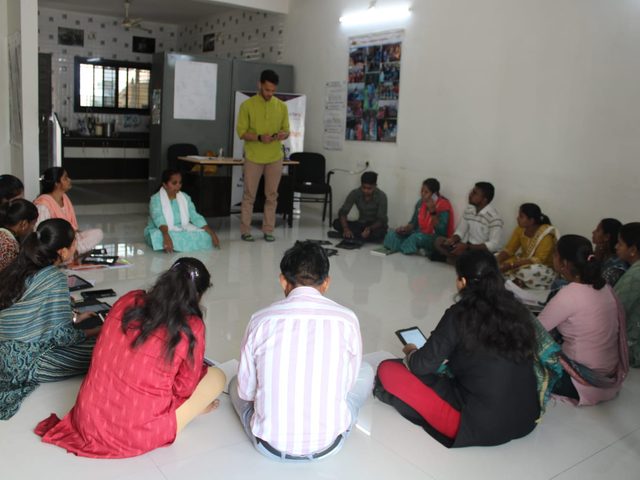
Built the migration methodology end to end, a 10-phase delivery pipeline from discovery to hypercare, an enablement toolkit, and a Frappe Helpdesk-based internal hub that coordinates every migration project.
World 03
Frappe · open-source
Across the stack, in the open.
Frappe Mobile (open source)
Product manager for an open-source Flutter-on-Frappe mobile platform: a client SDK (metadata-driven dynamic forms, offline-first SQLite sync) and a server app (mobile auth, OTP, force-update). Built so field apps work offline by default.
Frappe Helpdesk ticketing
Designing and building a Helpdesk-based ticketing and knowledge hub to run a multi-project delivery portfolio.
Internal delivery toolkit
Built a Claude Code plugin that encodes the whole Frappe build methodology, skills, agents, and safety guardrails, so the team ships consistently.
I read and review across the stack, data models, the security layer, the framework itself, not just configuration.
World 04
AI-assisted building
Rebuilt how delivery works.
Builder Protocol
A three-role, eight-phase AI-assisted delivery model, the Architect defines and decides, an AI tool builds, a human reviews before ship. It replaced a six-specialist SDLC and runs live across 5+ client builds. A memory layer keeps context, security rules, and decisions persistent across sessions.
Founded and ran an internal program teaching domain experts, not engineers, to ship real products with agentic tools, from vibe-coding to CLI, hooks, agent skills, and MCP.
5+ client builds running live on the Builder Protocol model. The Architect role is a product call, not a technical one: deciding what gets built, what does not, and why.
Each world card above opens into its own deep dive: more product detail, a stat band at the close. The dashed frames are waiting on real screenshots, not standing in for them forever.
Case files
Each case file opens with what was asked, then what the real ask turned out to be: the interview, made visible.
Healthcarein the hangar
Educationin the hangar
The ask
Make AI tools speed up software delivery.
The real ask
Enterprise delivery where specs, builds, and QA all queued on the same few people. Speed wasn't the constraint, headcount was, and no amount of faster typing fixes a queue.
The call
A three-role AI-assisted delivery model: Product Builder, System Architect, Account Manager, agents inside the loop, humans owning review and sign-off.
What shipped
The protocol running across three enterprise accounts, from spec to verified build.
Proof
Running across three enterprise accounts, spec to verified build.
The ask
Build an election-day logging tool.
The real ask
A state government needed election-day logging and citizen-facing e-Governance both, with student capacity as the only build resource. The tool was the smaller half of the problem; structuring 20+ interns into shippable workstreams was the real one.
The call
Structure a 20+ intern cohort into shippable workstreams.
What shipped
The logging system and the e-Governance build, live for the 2022 cycle.
Proof
Live for the 2022 cycle, shipped with a 20+ intern cohort.
The ask and the real ask are rarely the same sentence. Every case file opens with both, so "interview first" is a format here, not a claim I'm asking you to trust. The two ghost cards are queued, not built: a roadmap should be able to say that out loud.